Arrive, Connect, Leave: A Calm Plan for UK Business Networking
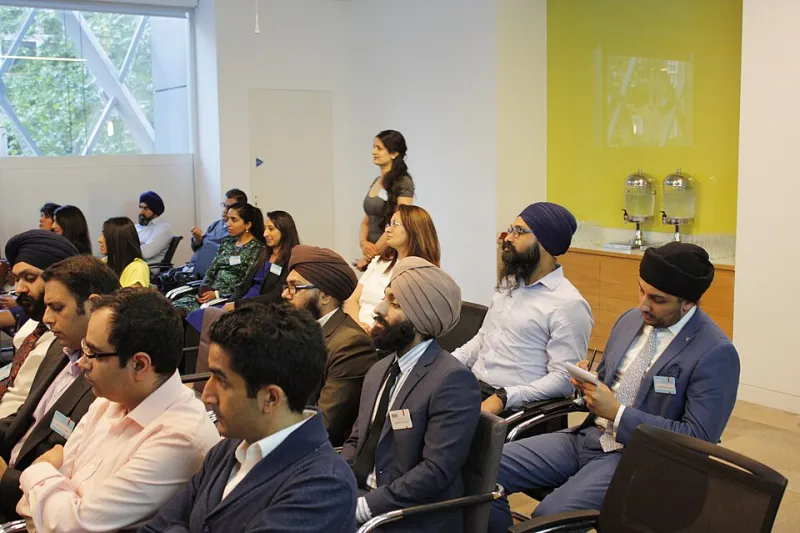
Photo: Englishseva, CC BY-SA 4.0, via Wikimedia Commons
Networking has a reputation problem. It is often presented as a performance: enter the room, deliver a pitch, collect contacts, leave. In UK business settings, that approach tends to fall flat. British professional culture generally rewards understatement, curiosity and a light touch. The aim is not to sell yourself loudly; it is to be remembered as someone worth speaking to again. For international professionals, that can be a relief. It also requires a plan.
Decide what the event is for
Before you choose an outfit or rehearse an introduction, decide what would make the evening worthwhile. One learning goal and one connection goal are enough. The learning goal might be to understand how a sector is changing; the connection goal might be to meet two people from adjacent organisations. Write both down. This keeps you from drifting towards the drinks table and calling it networking.
Research the format and the audience. Is it a conference, a chamber of commerce reception, a professional association meet-up or a company open evening? Each has a different rhythm. A formal reception may begin with welcomes and a speaker; an informal meet-up may have people standing in loose groups. Check the attendee list if one is available, but do not memorise it like a script. Knowing that a particular organisation will be present is useful; reciting their latest annual report is not.
Prepare a one-line description of your work that a non-specialist can follow. Avoid job-title shorthand. 'I help client teams make complex processes clearer' is more useful than 'I am a senior transformation lead'. You are not pitching; you are giving the other person a handle.
The first five minutes
Arrive early enough to settle. Get a drink, put your phone away and look around. Approaching a pair or a group of three is usually easier than interrupting a tight circle. Stand at a slight angle rather than directly face-on; it reads as open without being intense. If you are nervous, say so lightly. 'I am new to this event — have you been before?' is a perfectly good opening. It gives the other person an easy role: guide.
Useful opening questions are specific and low-stakes:
- 'What brought you along this evening?'
- 'Have you been to one of these before?'
- 'What did you make of the session?' if there has been one.
- 'How did you hear about the event?'
Avoid 'What do you do?' as the first question. It is not forbidden, but it can feel like an assessment. Let it arrive naturally after a minute or two.
Keep the conversation balanced
A good networking conversation is not a monologue with a business card at the end. Aim to listen more than you speak, especially at first. When you answer a question, give a short answer and return the conversation: 'I work in operations, mostly on supplier relationships. What about you — how does your role connect to that?' This is sometimes called bridging. It keeps the exchange moving without turning it into an interview.
British small talk often begins with the weather, travel or the venue. Treat these as warm-up, not filler. 'How was your journey?' can lead to a useful conversation about where someone lives and how they work. Self-deprecating humour is common, but avoid irony that depends on shared cultural references. Be careful with 'How are you?' — in the UK it is usually a greeting, not an invitation to describe your week.
Leave well
Many international professionals find the exit harder than the entrance. A graceful exit protects your energy and leaves a good impression. Signal the close before you turn away: 'It has been good to meet you. I am going to circulate before the next session.' Or: 'I promised myself I would speak to a few people from the public sector while I am here — may I connect with you on LinkedIn?' If you have promised something, name it: 'I will send you that article tomorrow.' Then do it.
Avoid backing away mid-sentence or looking over the other person's shoulder. If you are stuck in a conversation that has run its course, use a specific reason: 'I need to catch the speaker before she leaves.' It is honest and does not require an apology. A simple 'Thank you — I enjoyed our chat' is enough.
Follow up without a pitch
The follow-up is where many people undo a good conversation. Within a day or two, send a short message that references something specific. 'It was good to meet you at the Institute event last night. You mentioned the difficulty of onboarding new suppliers; here is the short guide I mentioned. No need to reply.' That is generous and low-pressure. It does not attach a CV or ask for a meeting in the first line.
If you would like to stay in touch, make the next step small: 'If it is useful, I could introduce you to my colleague who runs that programme.' If they do not reply, let it rest. One follow-up is courteous; three is a campaign.
Be memorable for the right reason
Memorability rarely comes from a polished pitch. It comes from a good question, a useful recommendation, a clear explanation of what you do and a clean exit. Choose one thread for the event — an interest, a problem you are working on, a resource you can share — and let it recur naturally. British understatement is your friend: 'I enjoyed our conversation' carries more weight than 'It was amazing to meet you.'
After the event, note two things about each person you want to keep in touch with. Not their job title alone, but the detail they shared. That detail is the beginning of a relationship, and the best follow-up is simply the one that remembers it.
Confidence at networking is not a personality trait; it is a set of small decisions made in advance. Arrive with a purpose, connect with curiosity and leave with grace. The sales pitch can wait.